
1. STRATEGIC POSITIONING
1.1. NIKE INC.
Nike Inc. is one of the most popular American brands that is known for its athletic and apparel segments. Its mission statement is “Bring inspiration and innovation to every athlete in the world”. Its vision statement focuses on development and brand strength. Its core values are diversity, community, sustainability, and social responsibility.
Its objectives include:
- Improve Nike’s position as the number one brand in America.
- Provide innovative and quality products and services both locally and internationally.
- Enhance the company’s capacity to develop products that suit women.
- Effectively direct and manage the brand’s international business (Nike, 2020).
Its STP includes:
- Segmentation: demographic, behavioural, and geographic.
- Targeting: athletes and sportsperson.
- Positioning: A leader in sports goods.
Contact us now to get more free samples
1.2. Macro Environmental Analysis
PESTLE analysis identifies the external factors that discuss opportunities and threats in the macro environment. It discusses the factors that impact NIKE’s strategic decision-making processes. Due to the presence of major competitors like Adidas and Puma the brand should address these external factors to maintain its position. The PESTLE analysis of NIKE is:
- Political factors affecting Nike: The USA has great policies for growth that are beneficial for the brand such as low interest rates and tax regulations. However, the brand is subject to tax changes and manufacturing laws. Also, the brand needs stable political conditions in local and international markets to grow its business. Many political conflicts can impact custom related processes and hinder exports and imports.
- Economic factors significant to Nike: The Company’s business performance is dependent on the markets where it sells its apparel and athletic footwear. The economic factors that affects Nike’s performance are:
- The economic stability of developed countries such as America provide Nike the opportunity to grow slowly but constantly.
- The brand can rapidly grow by advancing its operations in high growth developing countries.
- The Chinese economic decline may threaten the brand’s performance as it is increasingly dependent on the Chinese market for equipment and sports shoes.
- Social factors impacting Nike: The brand has the opportunity in developing countries to attract consumers due to the increasing consumers’ wealth. It can produce sustainable products and design effective marketing campaigns that can highlight its products. Also, by adopting development strategies that target the need for products that can be used for leisure activities, the brand can enhance business growth (Alsaffar, 2020).
- Technological factors in Nike’s business: The brand changes its strategies according to the newly available technology for business processes and equipment. The external technological factors that affects the brand are:
- The increasing investment in R&D (Research and Development) threatens the company as competitors are developing more technologically advanced apparel, shoes, and equipment.
- The brand is also threatened by the rapid technological obsolescence as it influences the company to enhance its efforts in product development.
- The company also has an opportunity to integrate mobile technologies in its product to attract individuals who spend their majority of their time on mobile for online shopping.
- Environmental factors influencing Nike: The brand has the opportunity to improve its sustainability programs due to the rising environmental concerns. These programs can be used climate change that influences supply chains and the quality of Nike apparel and footwear in certain regions. However, the rising sustainable strategies adopted by many companies pressurized the brand to increase sustainability efforts in its business.
- Legal factors in Nike: For Nike, improved employment law in developing markets is a threat as it may increase the labour cost. However, it also provides an opportunity for the brand to adopt high standards for labour. It can also improve its image by highlighting customer satisfaction in brand marketing strategies (Rowland, 2017).
Contact us now to get more free samples
1.3. Industry and Sector Analysis
Nike’s industry and sector analysis can be carried out through Porter’s five forces analysis. It discusses the five important forces that affect competition and profit in any industry.
- Bargaining power of suppliers: As the brand’s products are produced globally in 620 factories located in 42 countries, the bargaining power of suppliers is low. This large number of suppliers reduces the chance to pressurize the brand. It uses private contractors as suppliers in cheap labour countries such as Thailand, China, and Indonesia. That is why they have a huge influence over these factories and can easily switch between them.
- Bargaining power of buyers: Nike has been listed as the number one brand in the Forbes list; therefore, it has some major competitors. Therefore, brand bargaining power is high to moderate as much high-end apparel and sportswear brands are available in the market (InnoValor, 2018).
- The threat of substitutes: There are severalbrands in the market that offer similar sports and footwear products such as Adidas, therefore, the threat of substitute products is low to moderate for Nike. Many brands offer similar products at low prices compared to Nike. However, the threat is moderated by the design and quality of Nike’s products.
- The threat of new entrants: The threat for new entrants is low to moderate. Although the investment is not huge still there are some requirements such as production, marketing, supply chain, and distribution. Similarly, for new entrants, it is not possible to develop a brand image immediately like Nike.
- Level of competitive rivalry: The sports industry has a strong level of competition. The major competitors of Nike are Adidas and Puma. They are engaged in strong competition to penetrate inside the market to seize the market share from each other (Porter, 2002).
1.4. Competitors Landscape:
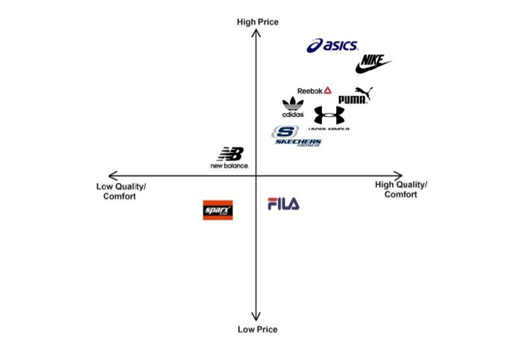
The position of Nike’s competitors is shown through a perceptual map. It shows how customers see different competitors.
Nike is following many strategies that have helped the brand to become the world’s leading athletic wear, footwear, marketer, and distributor. The key Industry Success Factors of Nike are innovation, brand equity, global presence, marketing, customer base, product range, and consumer loyalty. The perceptual map indicates that Nike offers high quality and comfort which has contributed to the increased customer loyalty, customer base, and innovation. Moreover, the major competitors of Nike such as Adidas, Puma, and Reebok also offer similar characteristics such as comfort, high quality, and innovation (Mahdi, Abbas, Mazar, and George, 2015).
2. STRATEGIC CHOICES
Figure 2: Nike’s financial data 2014 – 2020
Source: Macro trends, 2020.
Moreover, to run a successful business, Nike should take into consideration the Key Performance Indicators (KPI) as it affects the supply chain. The Key Performance Indicators of Nike are:
- Delivery reliability: If Nike products are not delivered on time and in good quality, they might lose their position in the market.
- Responsiveness: It is achieved through Order Fulfilment Lead Time. The brand has adopted a ‘Lean Approach’ to produce better products that reduce waste, decreases the time in the supply chain, and less defective products.
- Customer Satisfaction: If Nike’s customers are unhappy they could lose them and their market image. That’s why the brand works hard to satisfy its retailers and consumers that purchase its products. It also offers a program to its retailers known as future order in which retailers are allowed to order 5 to 6 months prior to delivery with a fixed price and promised timely delivery (Balm, 2014).
2.1. Internal capabilities
Nike’s brand positioning in the target market is supported by its efficient marketing mix program. Its 4P’s elements differentiate it from its competitors. It has designed its products especially for athletes and sports events as the products are highly comfortable for the athletes. Its prices are higher than most of the brands as it offers high quality apparel and footwear. Moreover, the brand promotes its products in the NBA and NFL. With US culture dominated by Football, the brand sponsored most of the NFL events. For its global marketing, it has successfully teamed up with soccer and the FIFA world cup (Flynn, 2015).
Below is Nike’s SWOT analysis that highlights the internal capabilities of the brand.
SWOT Analysis:
Contact us now to get more free samples
